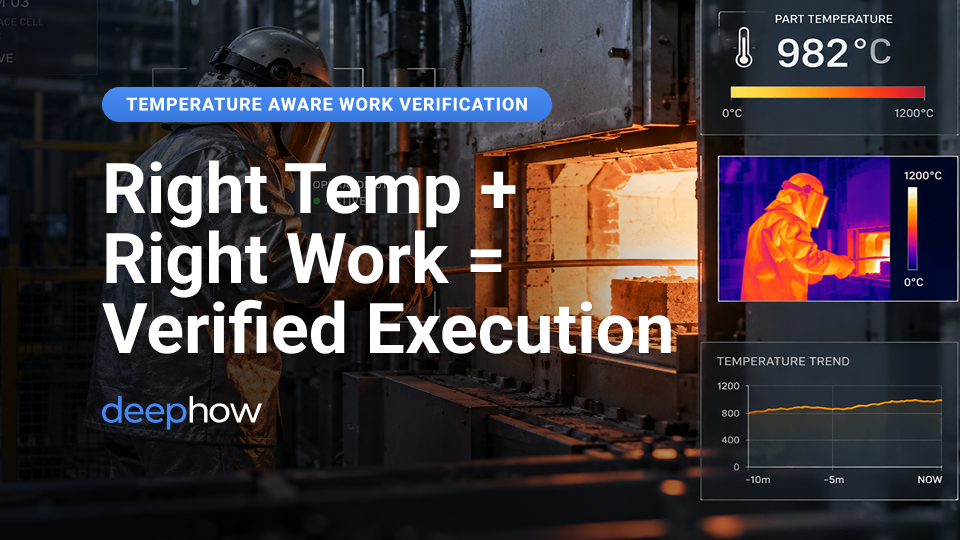
DeepHow's Temperature-Aware Work Verification combines a thermal agent with configurable vision skills and SOP verification agents to ensure work is performed at the correct temperature.
Poor quality can consume 10–25% of a manufacturer’s operating economics. Temperature-dependent processes create a particularly difficult source of that loss because the finished product may not reveal whether the work was performed correctly while the material was within its required thermal window.
For a billion-dollar manufacturer, even a small share of those losses tied to temperature-sensitive processes can translate into millions of dollars in scrap, rework, lost capacity, and investigation costs.
This is not a new manufacturing challenge. For centuries, skilled metalworkers have understood that the work and the material's temperature must be right at the same time. A master swordsmith can execute every hammer strike with precision, but if the steel is outside the proper temperature range, those same actions don’t produce the intended result. The temperature matters. The work matters. And most importantly, the outcome depends on their alignment.
Modern manufacturers face the same challenge at industrial scale.
Today, manufacturers can measure a component’s temperature. They can also observe the work being performed. But those two views typically remain separate. Reaching the right temperature doesn’t prove the right work happened within the required thermal window.
DeepHow is changing that.
Temperature-Aware Work Verification combines temperature sensing, visual intelligence, and Live SOP Verification. Manufacturers can link thermal readings to specific operator actions, confirm work happens within the approved temperature range, and create a traceable record of how the process was executed.
For a global energy technology company, that means transforming the manufacturing process of a high-value component. The component must be heated and maintained between 1,200 and 1,400°F before specific work can begin. DeepHow’s solution provides real-time confirmation that the process was completed under the required thermal conditions. At enterprise scale, ensuring thermal process compliance translates into millions of dollars in savings for this manufacturer.
How NVIDIA AI Powers Temperature-Aware Work Verification
Running on NVIDIA DGX Spark, Temperature-Aware Work Verification brings temperature data together with DeepHow’s visual intelligence and Live SOP Verification capabilities. It is part of DeepHow’s broader physical AI platform, which uses NVIDIA AI technologies across a range of visual intelligence applications.
DeepHow works with technologies including NVIDIA Cosmos open world models and NVIDIA Metropolis VSS Blueprint to support the development of video analytics AI agents that understand complex human actions, work sequences, and operational context.
The Opportunity Across Temperature-Critical Operations
Temperature-Aware Work Verification improves quality by evaluating and verifying all relevant physical conditions and work performed. The same challenge exists anywhere quality depends on coordinating physical conditions with human actions:
Oil and gas / Energy: Verify brazing, hardfacing, welding, heat treatment, and repair procedures on critical equipment and components.
Welding and heavy fabrication: Confirm preheat and interpass temperatures while verifying that joining procedures are performed correctly.
Forging and metal forming: Ensure billets and components are forged, bent, pressed, or otherwise worked within the required thermal window.
Automotive and heavy equipment: Verify induction heating, heat-assisted assembly, adhesive application, forming, and joining processes.
Aerospace: Create traceable verification for specialized welding, brazing, bonding, composite manufacturing, and repair operations.
Steel, aluminum, and foundries: Verify casting, pouring, rolling, forming, straightening, and heat-treatment work where timing and temperature directly affect the outcome.
Rail, shipbuilding, and heavy manufacturing: Confirm that welding, forming, joining, and repair work occurs at the required preheat, working, and cooling temperatures.
Electronics and battery manufacturing: Verify thermal bonding, curing, sealing, joining, and other temperature-sensitive assembly processes.
A Foundation for the Next Operational Use Case
Thermal process compliance is a high-value application, but the underlying architecture enables broader opportunities.
DeepHow is extending the platform with a more modular approach to visual intelligence, allowing manufacturers to configure applications around virtually any operational use case. Companies can combine vision skills and sequence them around the needs of a specific process.
As processes change, those applications can change with them. Manufacturers gain the flexibility to adapt visual intelligence to their operations without being limited to fixed, predefined use cases.
Temperature-Aware Work Verification is one example of what this architecture can enable.
Right component + right temperature + right action + right sequence = verified work.

.jpg)

Start capturing, structuring, and activating your expert
knowledge today with a 14-day unlimited free trial.