Author: Siva Lakshmanan, CEO
The physical world is facing an industrial strain and demand shock unlike anything seen in decades, thanks to the industrial revolution fueled by AI.
While Lean Manufacturing is often associated with post-war Japan and the Toyota Production System, its foundations were laid decades earlier. Frederick Taylor’s scientific management and Henry Ford’s moving assembly line introduced the principles of standardization, flow, and the systematic reduction of wasted motion.
Those ideas advanced rapidly during World War II, when the United States had to produce aircraft, vehicles, weapons, and equipment at unprecedented scale while bringing millions of new workers into factories. Programs such as Training Within Industry helped companies standardize work, develop supervisors, and improve production at extraordinary speed. In the decades that followed, Taiichi Ohno, Eiji Toyoda, and others at Toyota adapted these lessons to a very different environment, one constrained by capital, inventory, and production volumes, ultimately creating the Toyota Production System and the foundation of what we now call Lean Manufacturing. An incredibly powerful set of tools and processes designed to wage war on waste.
It is not that these principles did not resonate with people; Lean is very commonsensical, because the idea is simply to eliminate waste, standardize the best way of doing work, learn from the people who actually do the work, and keep improving it over time. The hard, often impractical part has always been making that improvement truly continuous, because you cannot realistically have someone standing behind every operator, observing every process every day, and updating how work should be done as things change. Paper instructions become outdated, experienced workers leave and take a lot of knowledge with them, bottlenecks shift from one part of the process to another, and small variations in how work gets done slowly build into meaningful operational drift.
Over the past two decades, there have been several attempts to digitize Lean and use software to make some of these practices easier to adopt and scale, whether it was digital Gemba, connected frontline worker solutions, digitizing Kanban, Excel-based time and motion studies, or digital approaches to value stream mapping. These tools certainly helped move individual activities away from paper and made some processes more efficient, but they never fundamentally changed how Lean was practiced. In most organizations, they remained tools used by industrial engineers and continuous improvement teams rather than becoming something that could continuously understand what was happening on the factory floor, and drive improvement at scale.
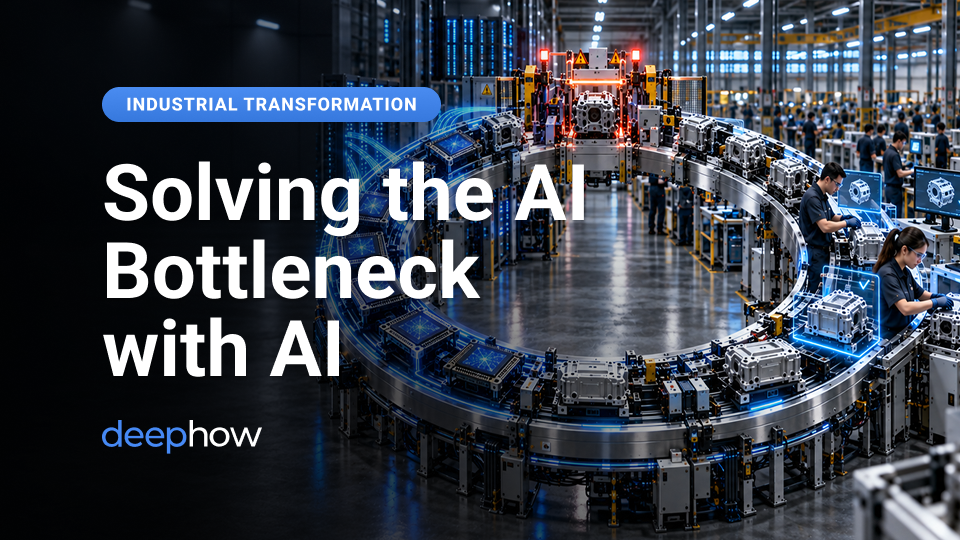
Today, a fascinating paradox has emerged: AI created a massive industrial bottleneck, and funny enough, AI is the only force capable of solving it. Necessity is knocking on the doors of invention.
It’s not too dissimilar from the Ouroboros (the serpent eating its own tail), which spans over 3,000 years, tracing a path from ancient Egyptian funerary rites into Greek alchemy, Gnosticism, and modern psychology. It’s the ultimate emblem of eternal recurrence, self-sufficiency, and the conservation of all existence. The serpent eating its own tail signifies that the world constantly feeds upon itself; nothing comes from outside the loop, and nothing exits it. Ouroboros is what’s happening today with Lean: it is undergoing a rebirth under the pressures of industrialization driven by AI, but AI will ultimately make Lean possible.
We often view the AI revolution as purely a software phenomenon, but in reality, AI is also driving one of the largest physical industrial build-outs we have seen in decades and contributing to a massive US manufacturing boom. Countries have been looking for a catalyst to rebuild their manufacturing base, and AI has unexpectedly become one. Behind every advanced AI model is an enormous physical supply chain that now has to operate under extraordinary pressure, from high-density rack servers and specialized processors to thousands of miles of fiber and copper, precision wiring harnesses, switchgear, liquid cooling systems, transformers, and countless other mechanical and electrical components.
In other words, to build the digital future, we first have to build an extraordinary amount of physical hardware, at a pace the industry has rarely seen and with very little room for defects. That pressure is bringing Lean manufacturing back to the center of the conversation, because manufacturers once again have to find ways to improve throughput, quality, productivity, and consistency at the same time. More importantly, the scale of the opportunity is simply too large to solve through automation alone; it will require humans and AI working together to make the existing manufacturing system significantly better.
This is also very consistent with the original philosophy of Lean. Lean was never simply about replacing people with machines or automating every step of production. Taiichi Ohno’s thinking was deeply human-centric – similar to DeepHow’s – with concepts such as jidoka and Kaizen built around the idea that frontline operators are not just there to execute a process, but are an important source of knowledge, problem-solving, and continuous improvement.
The hyper-growth of AI infrastructure demands precision at scale, and AI itself provides the long-missing technical layer to serve the frontline worker. At DeepHow, we see this shift firsthand. AI acting as an intelligent amplifier for human capability:
By leveraging AI to capture, verify, and optimize human work, manufacturers can finally bridge the gap between theoretical Lean and everyday execution—making true continuous improvement an attainable reality for every factory floor.
A consulting firm can map a process, conduct time studies, and post standardized work instructions on a wall. But what happens six months later? Demand shifts. Experienced operators retire. New hires join the line. Unplanned downtime forces supervisors to improvise. Slowly, hundreds of tiny, unrecorded decisions pull the actual work on the floor away from the standard printed on the wall.
That is what makes adopting something as obvious as Lean a challenge: Continuous improvement requires continuous understanding of reality. Someone has to observe the work, measure the variation, determine if a shift is waste or an innovation, and update the standard. Toyota spent decades building a culture to do this manually. Replicating that discipline across dozens of global facilities has historically been challenging.
That brings us to right now. Technology enabling Lean is becoming vastly more economically critical at the exact moment AI gives us the power to observe and understand physical work at scale.
At DeepHow, we believe our Physical AI tools can finally make Lean both attainable and sustainable for all manufacturing floors. By bridging the gap between how work is supposed to happen and the realities of how it actually happens on the floor, AI gives manufacturers the continuous visibility needed to make standard work stick, empower frontline teams to innovate, and make true Kaizen a daily reality.
.jpg)

Start capturing, structuring, and activating your expert
knowledge today with a 14-day unlimited free trial.