How I saw interns and experienced employees enable positive change in huge organizations this summer.
Author: Sam Crews, Forward Deployed Engineer
Have you ever seen the meme: “Workspaces are experiencing age gaps… Me and someone’s dad for 8 hours a day,” usually followed by a veteran worker doing a TikTok trend with a younger colleague? It represents the dynamics we're in now, where, for the first time in history, five generations are all participating in the work environment.
I have seen this multigenerational dynamic play out on several manufacturing frontlines this summer. There is something powerful about it, especially as manufacturers are pushed to increase the productivity of newer employees while losing decades of knowledge and experience from their aging workforce.
So, how do we capture and transfer knowledge across our multigenerational and multilingual frontline employees to carry on the pride, traditions, and critical ways of working that make our communities what they are?
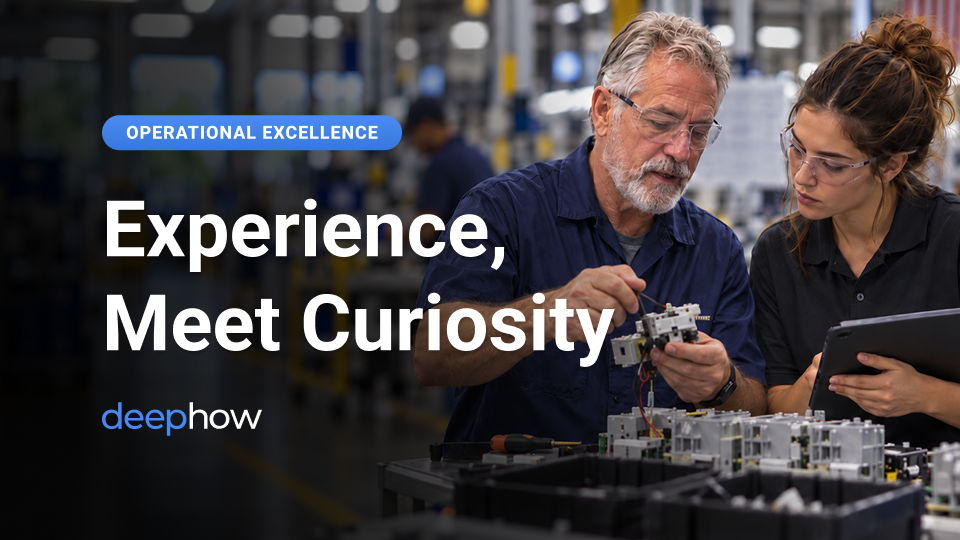
The answer isn’t simply about one generation teaching another. It is about what happens when people at different stages of their careers bring different strengths to the same challenge. Experienced employees bring knowledge, judgment, and context. Interns bring curiosity, comfort with technology, and questions others may no longer think to ask. Both have something to teach, and both have something to learn.
One large assembler of electrical components had recently won a global internal award for improvements to its training program. It rolled out DeepHow’s Knowledge Capture and Transfer across dozens of factories.
That award-winning team created dozens of training videos that were used as part of its Dojo program. A new employee would first watch someone perform a task, then do it themselves with help from a trainer. From there, expert-curated content walked the new employee through the work until they were confident enough to demonstrate through an assessment that they were ready for the shop floor.
Easy, right? In reality, it takes at least three key players, each bringing a distinct skill set. And often, those skills come from across generations.
First, a leader has to make it a priority by establishing clear goals, expectations, and measurable outcomes.
Second, someone with the knowledge has to be willing to share it and to be vulnerable enough to let others ask questions. The best sources are often a company’s most experienced people. In these examples, they were typically mid- to late-career employees.
Third, someone has to capture that knowledge and turn it into something others can easily understand and use. That requires someone who is comfortable working with video and AI, eager to learn, and excited to collaborate with others. In these examples, those people were often younger interns.
I saw this pattern at that award-winning company and three other customers. They made progress on important training and improvement initiatives with interns who wanted to prove themselves as people and professionals.
Those interns wanted to apply what they had learned, make an impact, and build relationships.
One of my favorite examples came from an intern who wanted a challenge. He wanted to see if our Smart Assist would correctly answer questions about wire terminations.
At first, it couldn't. But in that failure, he didn’t just dismiss the tech. He’s worked with AI throughout his everyday life. So through further experimentation, he discovered that the underlying content available to the AI assistant was lacking. He added more content for the AI assistant and kept testing until it could answer his questions correctly.
Another intern was tasked with creating world-class training videos to standardize training across a 21-plant enterprise. Take that in. This intern was tasked with creating videos that were accurate, engaging, and effective about manufacturing processes she knew little about.
It took her a little longer to learn the process she was documenting, but that unfamiliarity was exactly what made the result so effective. She had to ask questions an experienced person might no longer think to ask, creating training that was especially clear and useful for someone learning the process for the first time.
These examples spanned very different manufacturing environments, from power plant generators undergoing maintenance, repair, and overhaul (MRO) to electrical component assembly and highly orchestrated production processes with takt times measured in seconds. Yet despite those differences, each organization was confronting the same fundamental challenge that I mentioned above:
How do we capture and transfer knowledge across our multigenerational and multilingual frontline employees to carry on the pride, traditions, and critical ways of working that make our communities what they are?
The answer starts with people and with recognizing that different knowledge spans different generations, which technology can capture and scale.
The experienced employee brings years of judgment, context, and knowledge that may never have been written down. The intern brings curiosity, fresh technical knowledge, and a willingness to ask questions that others may have stopped asking. Leaders create the space for them to work together.
When it works, it can seem obvious and almost effortless. But it only happens when each person contributes, values what others bring, and works toward something they could not accomplish alone.
So what do someone’s daughter and someone’s dad do for eight hours a day in your facility?
.jpg)
.jpg)

Start capturing, structuring, and activating your expert
knowledge today with a 14-day unlimited free trial.