Process Optimization

Detect and Explain Process Drift

Small changes in how work is performed can have a major impact on cycle time, quality, and output. DeepHow applies specialized vision skills and agents to factory-floor video to compare execution patterns, identify the variaitions affecting performance, and uncover better ways to work.

The Problem

Processes evolve on the floor. Most teams only see the results.

Processes naturally evolve on the floor, but oftentimes organizations lack the visibility to understand what changed, whether it helped, and what should become the new standard.
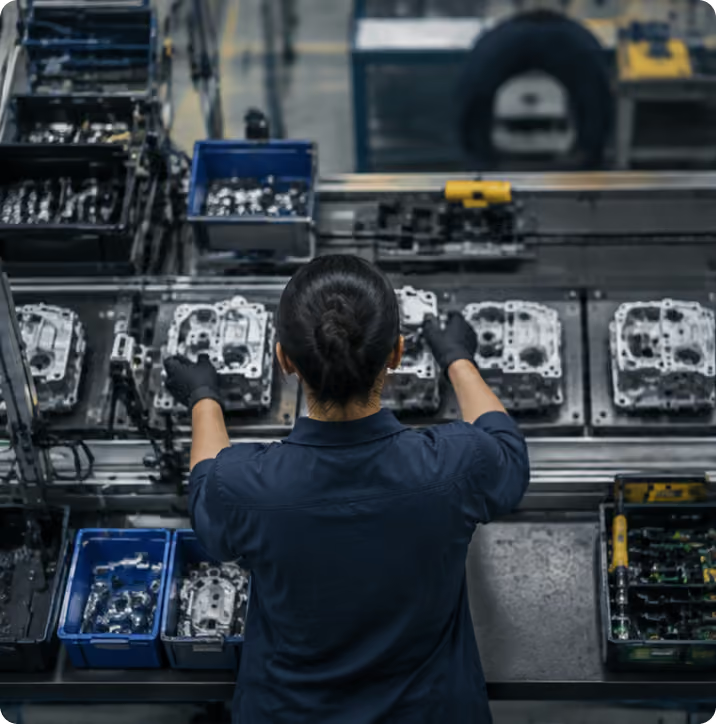
Process changes stay hidden
Operators adapt work across shifts and lines, but periodic audits rarely reveal where processes changed, how often, or why.
Better results can hide risk
Faster cycles and higher output may reflect better methods or shortcuts that introduce hidden quality and safety risks.
The best method is unclear
Better steps may be spread across different operators, making the right process difficult to identify, standardize, train, scale, and verify.
From the Field

What we hear on plant tours

Every one of these is a visibility problem wearing a different hat. Sound familiar?

Operations & Manufacturing
Plant Manager / Operations Leader
DIRECTOR OF OPERATIONS
"Line 1 is always better than the others. The only answer I ever get is 'experience.'"
PLANT MANAGER
"I don't really know what my best people are doing. They just get results"
VP MANUFACTURING
"We know that the plant in Ohio is faster. We can't tell you what they do differently though."
Quality & Compliance
Quality Engineer / Quality Manager
CI ENGINEER
"The SOP says one thing, the floor does another, and both pass the audit"
QUALITY DIRECTOR
"Yield dropped four points over a quarter. No single thing changed."
PLANT MANAGER
"We usually know something changed, but we don't know where or why until it whows up in an audit or quality issue."
The Solution

See How Work Changes and What Works Best

Understanding what changed, determining what processes work best, and scaling it across the organization.
Reveal How Work Changes
Compare execution across cycles, shifts, lines, products, and facilities to identify where processes have drifted and how work differs.
Connect Variation to Results
Determine which actions improve cycle time, quality, output, and safety, and which introduce hidden risk or inconsistency.
Turn Better Methods into Standard Work
Combine proven practices, update SOPs and training, scale them across operations, and verify that the new standard delivers the expected results.
Core Capabilities

Discover Drift. Teach What Works. Verify When it Matters.

Process Drift Analysis

Discover Drift

Compare how work is performed across cycles, shifts, and lines.
Detect recurring changes in sequence, timing and motion
Analyze execution across shifts, lines, products and facilities
See if improvements are sustained over time.
Knowledge Capture & Transfer

Teach What Works

Methods captured on video and organized into clear steps
Searchable, multilingual work instructions
Targeted learning for the steps that need to change
Updated methods quickly shared across the organization
Live SOP Verification

Verify When it Matters

For processes that require assurance on the spot
Real-time confirmation against the approved procedure
Immediate feedback before a missed step becomes a quality issue

Turn Process Variation into Better Performance

Reveal how work changes across cycles, shifts, and lines—then connects those differences to cycle time, quality, and output so teams can standardize what works best.

FAQ's

Questions we get

Is this employee monitoring?

No. The unit of analysis is the process, not the person. DeepHow reports on how a job is executed — sequence, method, timing, variation — so teams can find and spread the better way of working. Deployments are typically scoped and communicated with operations and labor partners up front, and the output that matters is a corrected standard, not an individual scorecard.

Do we need new cameras or sensors on the line?

Maybe not. Existing cameras can sometimes be used. DeepHow will work with you and your existing infrastructure to determine what would be best for your factory and specific use cases.

Our SOPs are out of date. Is that a blocker?

It's often the reason to start. When documented procedure and observed execution disagree, the comparison itself tells you which one is producing the better result — and gives you the evidence to rewrite the standard from proven production reality instead of assumption.

What does a first engagement look like?

Pick one job that runs on more than one line or shift and where the performance gap is real but unexplained. Analyze the variation, identify the best observed method, publish it as updated standard work and training, then verify adherence for a cycle. That loop is the proof case for scaling to the rest of the plant.

Find the best way to work, and make it the standard.

Identify process variation, understand what’s limiting throughput and scale process patterns that deliver the strongest results.