Manufacturers have spent decades making machines more visible. Sensors report temperature, vibration, pressure, speed, and utilization. All ready to give indications and information for someone to direct and act on.
Yet much of what operators do on the factory floor remains unseen and unmeasured: the actions they take, the steps they follow, and the small nuances that shape performance. Is the work being performed as expected? Where is it slowing down? How does it vary from one cycle to the next, and why does one station, shift, or facility perform differently from another?
Today, that understanding usually comes from industrial engineers observing a line, supervisors walking the floor, quality teams conducting audits, or operators explaining what happened after a problem occurs. These methods are valuable, but they are periodic.
Vision intelligence and vision skills change that.
Factories already have cameras. But most camera systems were built to record or detect.
They might identify whether a person entered an area, whether an object is present, or whether a basic safety condition occurred. They see something in the frame, trigger an event, and leave the interpretation to someone else.
Vision Intelligence and Skills go further.
They perceive what is happening. They understand the work in context. It's not about identifying or catching employees making mistakes, it's about comparing what it observes against the expected process, historical patterns, or the best-performing method.
Vision Intelligence can understand:
That is what turns a video feed into an operational understanding of how the factory is working.
Yet, the value comes when understanding leads to action.
When a process drifts off standard, an operator can be alerted while the part is still in front of them. When work begins backing up at a station, a supervisor can respond before the constraint costs an entire shift. When the same variation appears across hundreds of cycles, a continuous improvement team can determine whether the process needs reinforcement or whether the new method is producing a better result.
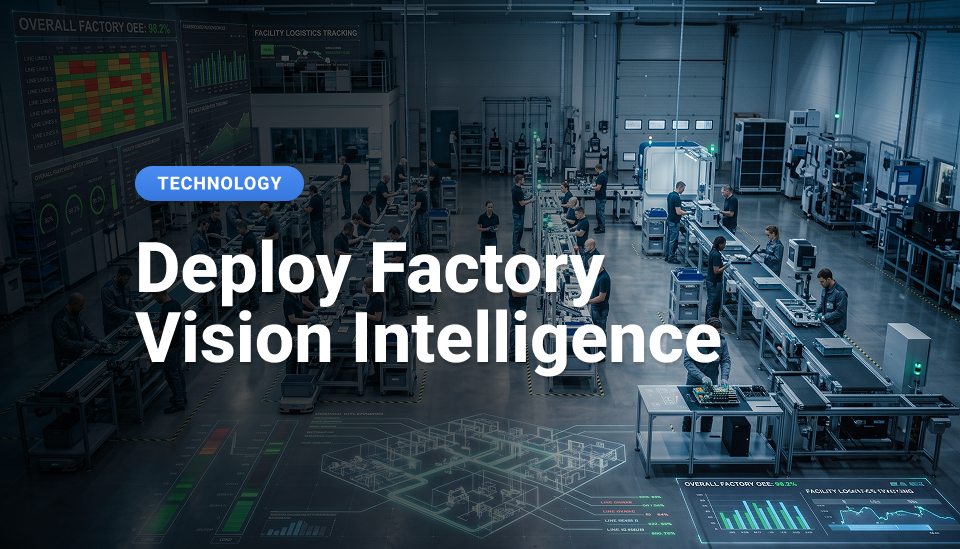
Vision Intelligence and Skills can operate at different levels of the factory, each answering a different operational question.
Factory-level understand flow: where work is backing up, where material is starved, where stations are idle, and where small stoppages or imbalances are quietly eroding throughput.
Task-level understand the method: whether work follows the correct sequence, whether steps or components are missed, whether unsafe actions occur, and where a process is drifting from the standard. They can also compare variations against cycle time, quality, and first-pass yield to determine whether a different method should be corrected or adopted as a better standard.
Conformance understand the result. They verify whether the completed work meets expectations while it can still be corrected such as whether a latch is seated, a component is present, a label is correct, or an assembly matches the required configuration.
Together, these capabilities give manufacturers a complete view of production: how work is flowing, how the work is getting done, and whether the outcome is right.
Start with a business case tied to a process your team already understands and measures. It can be tempting to begin with something entirely new and chase the biggest “what if,” but that introduces another variable at the exact moment you are learning a new technology.
You will run into questions and challenges. When the process, baseline, and expected outcome are already known, it is much easier to diagnose what is not working, make adjustments, and prove whether the solution is creating value. Soft benefits matter, but measurable improvements in cycle time, quality, throughput, or labor efficiency create the confidence and momentum needed to expand.
Choose a use case where results can be seen quickly. Yazaki North America began with Time & Motion AI, using vision intelligence and skills to automate the analysis of production work and uncover opportunities to improve line balance and workforce efficiency. They are cutting the time needed to execute time studies from weeks to days, moving from scheduled to on-demand studies, and saving millions of dollars annually with the investment.
Foxconn applied SOP vision intelligence to electronics assembly, verifying critical work against expected procedures. At their facility assembling GB-300 units they reduced quality incidents and improved First Pass Yield by 3%.
In both cases, the technology was applied to familiar, high-value processes where the impact could be measured thus creating a practical starting point for broader transformation.
.jpg)

Start capturing, structuring, and activating your expert
knowledge today with a 14-day unlimited free trial.