― Henry David Thoreau, A Week on the Concord and Merrimack Rivers
There's a version of a quiet factory floor that every operations leader dreams about. Machines humming. Operators moving with purpose. No alarms. No interruptions. No one waving you down with a problem.
It looks like excellence. It feels like control.
But is it?
Worker silence isn't always a signal that things are going right. Sometimes it's a signal that nobody knows they're going wrong.
A study of surgical teams found something counterintuitive: the most experienced surgeons received the fewest questions from their nurses and assistants. Not because everything was perfect but because the team had learned, over time, that raising a concern wasn't always welcome.
The silence in the operating room wasn't competence. It was an adaptation.
Manufacturing floors are no different. When operators go quiet when they stop flagging issues, stop asking questions, stop pushing back it rarely means everything is running perfectly. It usually means they've learned that speaking up isn't worth it. Or that nobody will listen anyway. Or that the pace of work leaves no room for it.
The question isn't whether your floor is quiet. It's why it's quiet.
Let’s apply this to the manufacturing floor. Meet Daniel. Twelve years on the assembly line. He knows the process better than the person who wrote the SOP. Over time, he's quietly developed a sequence that shaves forty seconds off a recurring task. His throughput is consistently higher than his peers, and his quality scores are strong.
Nobody knows why. Nobody has asked. And Daniel hasn't told anyone not out of secrecy, but because there was never a structured moment to share it.
Now imagine Daniel retires. Or transfers.
That forty seconds disappears with him. The improvement was never captured. It was never studied. It was never turned into a standard. And the organization has no idea what it just lost because on paper, everything looked fine.
But silence and process drift are not always a positive thing. It can lead to a “normalization of deviance,” or the gradual process by which shortcuts, workarounds, and process deviations become so routine that they stop feeling like deviations at all. These violations of standards or become normal behavior because no immediate negative consequences occur. And that can lead to devastating impacts.
It doesn’t happen overnight. It builds slowly over time, like a ticking time bomb.
The floor stays quiet. The metrics hold steady, and may even improve, because maybe these cuts are shaving time off the production runs. And the deviation compounds invisibly until the day it doesn't.
When there's no system watching whether the step happened or not just whether the shift completed, organizations are left to assume.And assumption, on a manufacturing floor, is an expensive habit.
“The quieter you become, the more you can hear.”
― Ram Dass
Silence is a signal. Before you can address it, you have to understand it. The silence that exists is a product of culture, leadership gaps, and a lack of tools that make sharing feel natural and effortless.
Step 1: Culture is the Root
Silence starts with culture. If your culture doesn't actively encourage knowledge sharing, no tool will fix it. People stay quiet when they feel their expertise isn't valued, when leadership doesn't model openness, or when sharing feels like extra work on top of an already full day.
Change management begins with a shift in mindset. Leaders have to go first. When leadership visibly champions the act of sharing knowledge, celebrating it, recognizing it, and making it part of how success is defined, the culture follows. A psychological safety net has to exist before anyone will willingly surface what they know, admit what they don't, or flag when something feels off.
Step 2: Make It Easy to Be Heard
Consider Daniel's story. He carries years of hard-won expertise and knowledge that lives in his hands, his instincts, and his daily decisions. So how do you capture it?
The world has already answered this question. People turn to YouTube to learn a skill, and to ChatGPT to think through a problem. These tools are frictionless. That same instinct exists inside your workforce. DeepHow harnesses it through video-based learning that makes capturing and sharing expertise as natural as recording a quick clip, turning one person's knowledge into a resource for everyone.
Step 3: Watch What's Actually Happening
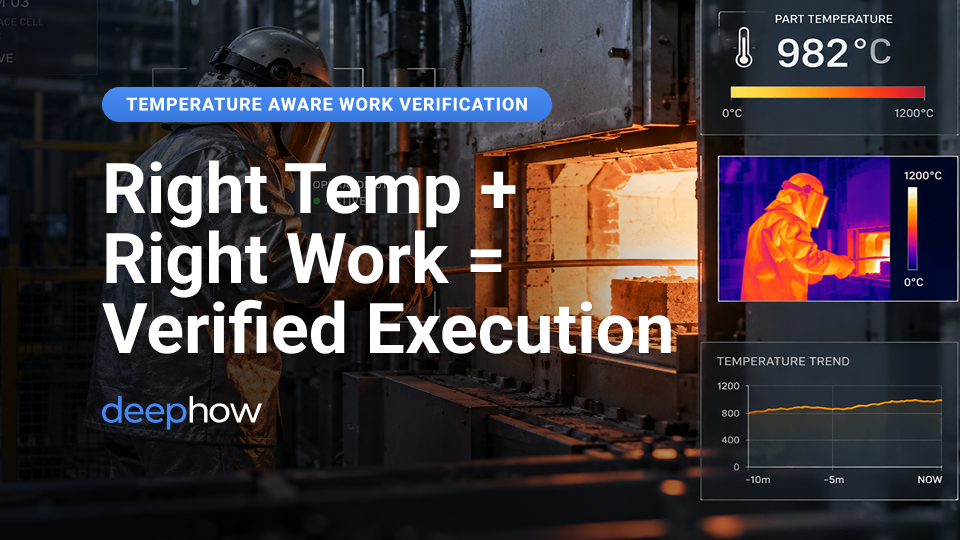
Catching drift requires retraining and visibility. You need to see processes as they happen, distinguish positive adaptation from harmful deviation, and verify that the desired behavior is occurring. DeepHow's Live SOP Verification makes this possible through vision AI that monitors every step in real time, and turns observation from a periodic audit into a continuous safeguard.
The cost of silence is invisible until it isn't. Earnest Hemingway’s iceberg or theory of omission, taught us that what is left unspoken carries the greatest weight. As a consequence, knowledge walks out the door. Drift compounds with unchecked deviation. Yet with the right culture, enablement, and tools you can turn your silence into noise, while still not making a sound.






.jpg)

Start capturing, structuring, and activating your expert
knowledge today with a 14-day unlimited free trial.