A well-prepared workforce has become the top priority in manufacturing, not only to meet rising SQDCE standards, but to ensure critical roles are filled and people become productive faster. As expectations for quality and safety increase, manufacturers are under pressure to get new and existing workers executing correctly from day one. At the same time, rapid technological change and shifting labor dynamics are accelerating the need for adaptive learning, rapid upskilling, on-site support, and SOP verification.
Work is evolving faster than traditional training methods can keep up. As processes, tools, and technologies change, people need real-time guidance to perform with confidence, especially when tasks are new or infrequent. This level of preparedness now has a direct impact on safety, quality, and overall operational performance. Seventy-five percent of manufacturers report that their EHS programs are not meeting expectations, and data from the Department of Labor shows workplace fatalities have increased by 30 percent since 2017. The status quo is not working.
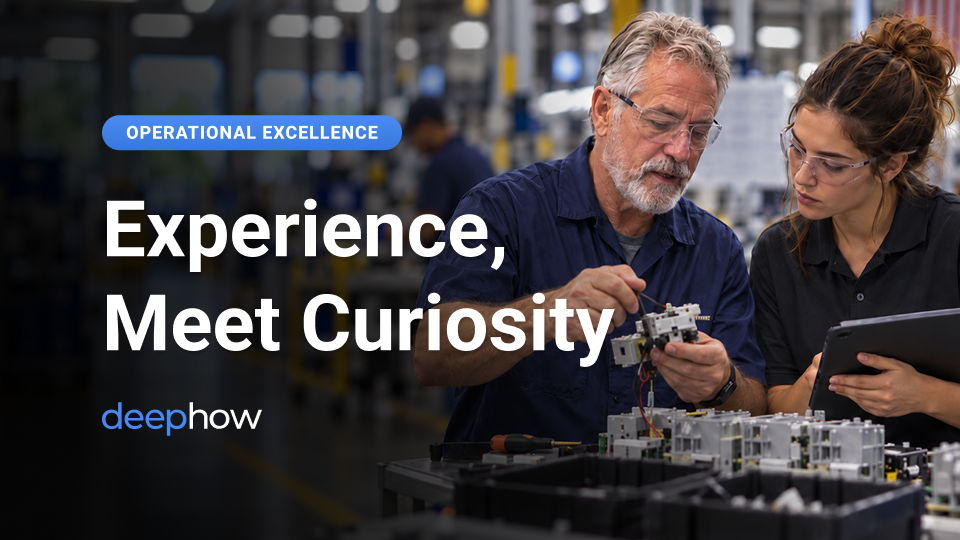
Common sense, backed by research, shows that teams with immediate access to expert guidance make fewer mistakes and resolve problems faster. But that support has to show up during the work itself. Until a task becomes true muscle memory, every technician needs some level of hands-on support when working with equipment, processes, and unfamiliar situations.
Labor, Skills and Perceptions
Despite declining manufacturing employment reported by the Bureau of Labor Statistics in 2025, equipping workers with the skills and knowledge needed to run modern operations remains a top concern for industry leaders. Deloitte’s manufacturing outlook highlights talent readiness as a critical challenge, driven not only by the aging workforce but also by the growing risk that labor gaps will widen further if reshoring in the United States accelerates.
The labor issue is not easily solved by hiring alone. Compounding the challenge is a long-standing perception problem keeping some of the best workers away. Many still view manufacturing jobs as unstable, low-tech, or undesirable, even as today’s facilities increasingly rely on advanced automation, digital systems, and sophisticated processes. High-profile plant closures reinforce concerns about job stability and can have devastating effects on local communities and livelihoods. When a single facility shuts down, entire regions feel the consequences, making it even harder to attract people into manufacturing roles.
Finally, there is the accelerating challenge of workforce aging and the loss of tribal knowledge that comes with it. Nearly 25 percent of today’s manufacturing workforce is 55 or older, and an estimated 2.1 million manufacturing jobs could go unfilled by 2030. As experienced workers retire or move on, they take decades of hard-earned knowledge with them. This includes lessons learned on the floor, workarounds developed under pressure, and practical expertise that was never formally documented.
International Wire Group, a major manufacturer of copper and copper alloys serving automotive, consumer electronics, and oil and gas markets, identified the potential loss of decades of tribal knowledge as a growing operational risk. That concern ultimately led them to choose DeepHow as a way to capture critical expertise and make it accessible to the next generation of workers.
The labor challenge in manufacturing is compounded by persistent turnover. Let’s be honest. Manufacturing is not for everyone. The work can be loud, physically demanding, and performed in hot or cold environments, all while requiring constant attention to safety. That does not mean people cannot succeed in these roles. The problem is that many candidates do not fully understand what the work actually involves until they are already on the floor.
As a result, even well-intentioned hiring decisions often lead to early exits. People join with one expectation, experience a very different reality, and decide the role is not for them. Accepting this level of churn as the status quo isn’t viable and the cost is inhibitive.
A better approach would be to filter earlier in the process. Simple tools like short videos that show what the work is really like, or structured plant walkthroughs for candidates, can quickly help people self-select out before they apply or accept an offer. While this may reduce applicant volume, it often increases applicant quality. Those who do apply are more informed, more motivated, and more confident that the role is a fit.
For those who do stay, better investments within them keep them around longer. Turnover costs extend far beyond hiring. When workers are not adequately supported on the job, frustration builds quickly. One HR leader shared an example of an employee so overwhelmed by a lack of guidance that they “were banging their head on the machine.” In another case, an experienced welder left a new role when they realized there was no support for learning the nuances of the current factory. Rather than continuously asking for support or guessing how to do it, he found it in his best interest to get another job.
The financial impact of this churn is substantial. One manufacturer reported hiring approximately 500 workers per quarter, with an expected 47 percent leaving within the first three months. That means 235 people are hired and gone every quarter. If we assume an hourly wage of $20 and 40 hours of initial training, the direct training cost per worker is $800. Across 500 hires, that equals $400,000 per quarter or $1.6 million annually for training alone.
With 47 percent turnover, roughly $752,000 of that annual training investment is lost before factoring in trainer time, SME support, reduced throughput, or the downstream impact on safety, quality, scrap, downtime, and delivery performance.
Excessive turnover also has impacts on existing staff: training resources are consumed, and subject matter experts become fatigued from repeatedly onboarding people who never reach full productivity.
The issue is not limited to new hires; it also involves generational disparities in upbringing. Today's machinery is far more sophisticated and precise, and fewer people had shop classes or practical mechanical experience as children. Because of this, employees now require more organized, visual, and encouraging training in order to perform with confidence.
Meanwhile, more and more workers are middle-aged professionals who are taking a new direction. They come with good experience yet they need modern, technology-based training according to their learning, styles, and needs.
The automation, digitalization, and competition compel the change in processes and tools to happen quickly. As technology advances rapidly, it takes time to train human skills. Leaders are putting growing pressure on reskilling teams without reducing production or causing more downtime.
Workforce Readiness Is No Longer About Training — It’s About Confidence at the Moment of Work
The majority of organizations think they have a training issue. In actuality, they struggle with performance confidence.
Workers are failing because the aid isn't available when it matters most, not because they weren't trained. When a frontline employee is standing in front of a machine, a customer, or a crucial decision, a paper document or large PDF file that was finished three years ago is not helpful.
This is where workforce readiness is radically altered by technology. Real-time task support, visual guidance, and immediate accessibility transform learning from something employees can recall to something they can depend on. Organizations can now incorporate expertise directly into the workflow, preventing errors before they occur and improving quality throughout every shift and location, rather than relying on employees to remember the correct step.
The Organizations That Win Will Be the Ones That Capture Knowledge and Act on It — Continuously
Undocumented expertise is a diminishing asset that every organization possesses.
Experienced workers are aware of the real work process, including the shortcuts, warning indicators, and quality checks that are never included in SOPs. Businesses lose consistency, safety, and speed in addition to skills when that knowledge departs.
The most successful organizations do not treat learning as a one-time event. They combine onboarding, in-flow job aids, and real-time support, then use AI to verify that standard work is being performed correctly in the moment. Progressive companies know that perfection is not achieved upfront. It is built through execution. By observing work as it happens, continuously refining guidance, and validating each step against the SOP, they turn learning into a living system.
With a strong leadership, culture, and the implementation of digital, on-demand, and AI-enabled training systems, organizations enjoy a tangible edge over those that use training methods that are outdated. Workforce readiness is more than operational--it is also strategic, measurable and core to competitive.
References
Bureau of Labor Statistics & EHS Data Overview. (2025). Workforce safety and performance trends in manufacturing. LinkedIn Events. Retrieved from https://www.linkedin.com/events/7388055075903983617/
Deloitte. (2025). 2025 manufacturing industry outlook: Talent and workforce readiness. Retrieved from https://www.deloitte.com/us/en/insights/industry/manufacturing-industrial-products/manufacturing-industry-outlook.html#talent
Business Report. (2024). America’s manufacturing revival faces a workforce reality check. Retrieved from https://www.businessreport.com/article/americas-manufacturing-revival-faces-a-workforce-reality-check
The Western Producer. (2024). Tyson to close beef plant as supplies dwindle. Retrieved from https://www.producer.com/livestock/tyson-to-close-beef-plant-as-supplies-dwindle/
YouTube. (2024). Manufacturing workforce challenges and community impact [Video]. Retrieved from https://www.youtube.com/watch?v=NRDSzb_lwSU
Mozec, J. (2024). Learning in the flow of work: Microlearning, AI tutors, and upskilling. LinkedIn. Retrieved from https://www.linkedin.com/pulse/learning-flow-work-microlearning-ai-tutors-upskilling-mozec
.jpg)
.jpg)

Start capturing, structuring, and activating your expert
knowledge today with a 14-day unlimited free trial.