Physical AI skills and visual agents are creating measurable value on the factory floor by reducing scrap, rework, safety incidents, and process variations.
Yet, as with many advancements, it is not the technology itself that drives value; rather, proper deployment creates value. Without a clear business case, a defined process, and a real problem to solve, new technology often generates initial interest, then fades into another forgotten pilot.
Here are four use cases where agents are already driving operational value.
One of the clearest uses for physical AI is verifying work while it is being performed.
Manufacturers have been asking the same question for a long time:
How can I confirm that operators are performing the task correctly without adding extra time, extra steps, or extra friction to their work?
Prior solutions usually added more process burden and rarely made it into production.
Physical AI skills and visual agents change that model.
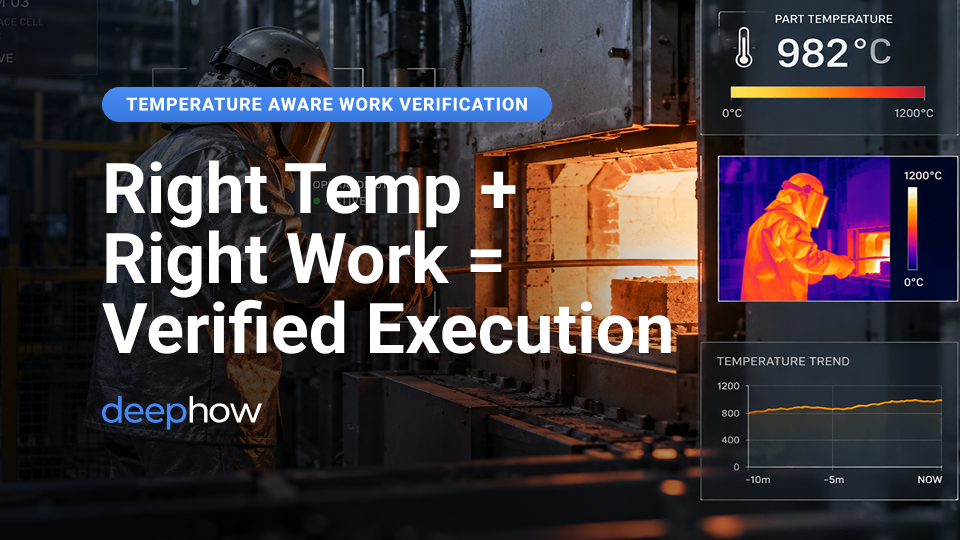
Instead of asking operators to stop, scan, photograph, or wear specialized equipment, physical AI can compare real-world activity against the approved process as the operator works. It can understand which step is being performed, whether the sequence is correct, whether a required action was missed, and whether execution is drifting from the standard.
Operators can receive feedback while the work is still in progress. Supervisors and quality leaders gain visibility into where execution varies, where the process is stable, and where intervention may be needed before a small deviation becomes a defect, delay, or rework event.
This capability is already in use at Foxconn.
At that factory, DeepHow is integrating the NVIDIA Metropolis Blueprint for video search and summarization (VSS) and the open Cosmos 3 model to develop a standard operating procedure agent to support the assembly of Grace Blackwell Ultra Superchips for NVIDIA GB300 NVL72 rack systems. Running on NVIDIA RTX PRO Servers, the SOP agent understands complex assembly motions and helps improve first-pass yield by 3%, minimizing rework and production waste.
Time and motion studies are core to Lean manufacturing. They help teams identify waste, improve line balance, reduce variation, and better understand how work is performed.
The challenge is that time studies are time-consuming and require manual effort.
A continuous improvement engineer or industrial engineer often needs to observe the process directly, record cycle times, break work into steps, and classify actions as value-added, waste, or necessary but non-value-added. Because the process is so manual, teams often rely on small sample sizes. That makes it harder to understand variation across shifts, operators, lines, products, and facilities.
Through agentic physical AI, teams can observe more cycles, classify more actions, and identify more patterns without requiring someone to manually record every movement. This does not replace the role of the continuous improvement engineer. It gives them better data so they can spend less time collecting information and more time applying expertise.
By doing this, time studies become what they were always meant to be:
Automating time and motion studies with physical AI can reduce the time required for traditional studies and the labor needed to collect and classify work data. Additional value comes when teams use that data to rebalance work, reduce bottlenecks, eliminate wasted motion, and increase throughput without adding people or lines.
Even with approved SOPs in place, execution can vary by shift, operator, line, and facility.
That variation is rarely intentional. It often happens because work instructions become outdated, tribal knowledge fills in the gaps, or different teams at different sites interpret the same procedure differently.
Over time, small differences become process drift. Process drift then becomes quality variation, rework, delays, and inconsistent performance.
As described in Use Case 1, physical AI can help manufacturers standardize execution by verifying work against the approved process in real time. But real-time verification is only one part of the equation.
Standardization also depends on the quality of the SOP itself.
Manufacturers need a shared SOP repository with robust version control, multilingual access, video-based work instructions, and the ability to capture knowledge from the best operators before it disappears. When that knowledge is captured, structured, and reused, it becomes an operational asset.
In practical terms, this means teams can reduce variation, improve execution consistency, and scale best practices across sites more effectively.
In safety-critical and regulated environments, deviations from standard work can create serious risk.
A missed step, outdated instruction, incomplete training record, or undocumented process change can lead to safety incidents, quality failures, audit exposure, and production delays.
Here again, there are many components to the solution:
On-demand visual inspection can also support teams by capturing photo or video evidence of completed work, a specified state, or specific outcome. AI can then compare that evidence against defined standards and provide feedback without requiring a supervisor to be physically present for every check. This is critically important for lower-volume or more infrequent, high-risk procedures.
This matters because compliance requires the right documents, training, and skills, as well as proof that the procedure was completed correctly.
When operators receive immediate feedback from an AI-enabled photo, video, or live verification workflow, they gain more confidence in their work. Supervisors gain better visibility. Quality and compliance teams gain stronger evidence. The organization gains a more reliable way to reduce risk without adding unnecessary manual oversight.
ArcelorMittal, one of the world’s most advanced steel finishing facilities, reduced safety incidents by 78% and delays by 49%. They found that work instructions were not always aligned with what was happening on the floor. DeepHow helped identify those gaps and surface safety issues that had not yet been addressed.
The immediate value of physical AI on the factory floor lies in its ability to seamlessly integrate into existing workflows without creating friction for the workforce. Whether it is ensuring safety, automating time studies, or standardizing SOPs, this technology can serve as a continuous, intelligent partner for human operators.
If you want to see these solutions in action, come visit us at Booth 775 at Automate 2026 or request a demo.

.jpg)

Start capturing, structuring, and activating your expert
knowledge today with a 14-day unlimited free trial.